

Human-Centered Leadership Foundations
Leadership structures, operating agreements, and cultural foundations that create workplaces where commitment, presence, and integrity become the norm.
Culture doesn’t change because leaders announce it.
Organizations often declare new values or cultural aspirations.
But culture is shaped by the everyday systems that guide how leadership actually happens — how decisions are made, how responsibility is shared, and how leaders work with people and power.
Human-Centered Leadership Foundations help organizations design those systems intentionally.
What Shapes Workplace Culture

Workplace culture is not defined by values statements alone.
It is shaped by the structures and agreements that guide how leaders behave every day.
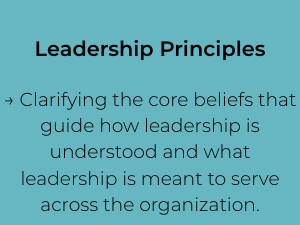
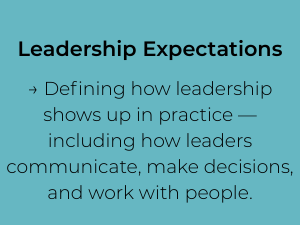
Human-Centered Leadership Foundations help organizations create clarity around:
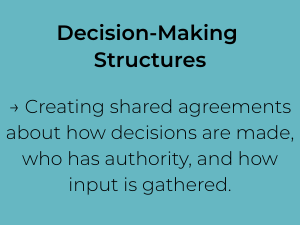
how decisions are made
how power and authority are used
how responsibility and ownership are defined
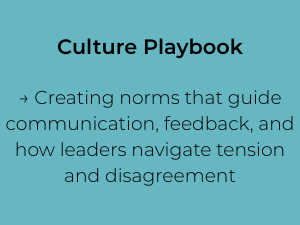
how leaders work through conflict and tension
how feedback and accountability happen
how leaders guide people through change
These foundations create the conditions where commitment, presence, and integrity can become the norm.

What Organizations Gain Through This Work
A Human-Centered Approach to Culture
Culture work starts with leadership development.
Too often, organizations attempt to drive culture change before leaders have the capacity to lead that change.
But culture is shaped in how leaders show up — especially in the moments that matter.
Pressure.
Conflict.
Uncertainty.
Responsibility for other people.
A human-centered approach to culture recognizes that culture is shaped not only by systems, but by how leaders show up within them.
It focuses on strengthening leaders’ capacity to work with power, navigate fear, and lead with integrity — so the desired culture can actually take hold.
The Foundations of This Work
Human-Centered Leadership Foundations are grounded in the StartHuman Way — an approach to building leadership systems and structures that help leaders work consciously with power, fear, and vulnerability
Choose Commitment Over Compliance
Leadership always involves power — the power to shape decisions, influence direction, and affect other people’s lives.
Standing in service invites leaders to orient toward serving people, creating value, and inspiring commitment.
Choose Presence Over Protection
Fear is a natural part of leadership, especially when the stakes are high.
Befriending fear means noticing when it appears and staying present with it rather than allowing it to quietly drive behavior, conversations, or decisions.

Choose Integrity Over Relief
Vulnerability is part of being a leader.
Sitting in the fire means noticing the pull toward relief—avoiding the conversation, softening the truth, disconnecting from the experience and choosing to remain aligned with who you want to be instead.
Design the Systems That Shape Your Culture
Workplace culture is not accidental.
It is built through the structures and agreements that guide how leaders make decisions, share power, and work together.
What Our Clients Say
-
![Lisa Curtis]()
Lisa Curtis, Founder and CEO of KuliKuli Foods
We have spoken to a lot of leadership coaches and facilitators over the years. It’s clear that lots of people can talk business strategy. Amber, on the other hand, gave us the foundation we needed and the tools we craved to improve communication and work better together. With her help, we’ve cultivated an environment where people feel included, excited, and motivated to bring their best.
-
![Mary Beiriger]()
Mary Beiriger, Director, Career Management, Passport Services
We’ve been working with StartHuman since 2019 and every experience has been outstanding. Amber is truly remarkable, delivering exceptional service that always surpasses our expectations. She took the time to listen to our challenges and quickly demonstrated a deep understanding of our organization, skillfully navigating our complexities and bureaucratic limitations. She has supported key efforts for leaders at all levels such as Dare to Lead, Change Management, executive coaching, and other leadership training. Her expertise and commitment set her apart as she found creative and effective ways to help us work within our constraints, demonstrating her adaptability and commitment to customized solutions. This blend of expertise, personalized support, and innovative problem solving makes Amber and StartHuman an unparalleled choice for tailored and impactful solutions.
-
![Matt Edwards]()
Matt Edwards, Vice President, SWCA Environmental Consultants
I’m better equipped to lead my team and contribute to a culture of candor, accountability and trust. As a coach, Amber never let me off easy, always challenging me to dig deeper into my own motivations so that I can show up for my team from a place of honesty and integrity.
-
![Gary Brooks]()
Gary Brooks, CEO, Nevada Infusion
Amber’s customizable, holistic approach sets her apart from other executive coaches. She helped me become a more effective and empathetic leader in all areas of my life.
-
![Dr. Ginger Carlson]()
Dr. Ginger Carlson, Director Curriculum, Teaching, & Learning and Educational Consultant
Amber was the perfect person, delivering the perfect message, at the perfect time.
We’ve partnered with Amber for multiple keynotes and leadership sessions. Each time, she makes sure to dig in to understand what we need as an organization. Then, she crafts a message to support us, leaving our attendees feeling more open to vulnerability, more resilient to the changing world around us, and ready to tap into the courage that allows them to make a bigger impact.
-
![Lindsay Bradley,]()
Lindsay Bradley, Vice President, Administration | LeisureQuip, Inc. / Relentless Fulfillment, Inc.
We developed our performance management process with Amber. As a result, we see team members going out of their way to do more because they feel empowered and appreciated.
Amber and I worked together to translate our core values and desired behaviors into a year-long learning journey for our employees. We incorporated emotional intelligence, feedback training, self-leadership, situational leadership, and coaching essentials. Not only have I noticed increased longevity in our people, but I'm watching our team lean in, work harder, and solve problems on their own. I am constantly impressed and grateful by Amber's ability to customize everything to accommodate our hybrid work environment and ensure our company values are infused into every interaction.
-
![Brenda Davies]()
Brenda Davies, Head of Oncology Training and Development
I recommend Amber to any team looking to become better leaders and humans. If you’re willing to put the work in, you’ll get a lot out of it.
My team wanted to get on the same page about what a good leader should look like. I initially chose Amber because she’s a trained Dare to Lead facilitator, and I’m a huge Brene Brown geek. However, it was immediately apparent that Amber took it a step further. She instantly incorporated feedback and personalized the program to meet our goals.
As a result, I’ve noticed my team engaging in more open conversations and have gotten feedback that they’ve taken the work into their personal lives.
-
![Sarah Sappington]()
Sarah Sappington, Director at SWCA Environmental Consulting
I used to compare myself to other leaders and feel like I wasn’t good enough. Amber helped me recognize my strengths and celebrate the things that made me a good leader.
Through working with Amber, I was able to gain self-acceptance, self-compassion and recognize the specific areas that needed improvement. As I worked on myself, I became a better leader. The more I grew, the better I was able to support my team. Working with Amber was both challenging and exciting. I truly valued our time together and recommend her to anyone looking to develop as an individual or as a leader.
-
![Josh Ashcroft]()
Josh Ashcroft, Chief Housing Officer, Eastern Washington University
Amber became a partners who were invested in my team and what we were trying to accomplish as an organization. The level of authenticity towards my team members is what separates her from other trainers and coaches I’ve worked with. She cares about you as a person not just a client.
-
![Morgan Massie]()
Morgan Massie, Senior Manager of Client Services, TriNet
We have seen positive, tangible results and an increase in engagement and skill development from those on our team who have participated in the programs.
-
![Raymond Schmidt]()
Raymond Schmidt, Lower school principal at the American School of Guatemala
Amber has a very comfortable, genuine, and natural presence that makes her easy to work with. Because of that, people were opening up, sharing, and reflecting deeper than they normally would with presenters. Since listening to her speak, we have made some concerted efforts to strategically and purposefully plan team building activities centered around cultivating relationships.
-
![Emily Nelson]()
Emily Evans Nelson, Firm Administrator, Evans, Nelson & Company, CPAs
As accountants, we want to rely on numbers, facts, and things that balance. Humans don’t balance or make sense the way numbers do. The fact that Amber has training through experts like Brené Brown lends a lot of credence to the work she does. Her training, in combination with her relatable and trustworthy personality, got us to open up quickly and be receptive to new skills which allowed us to thrive as a team.
-
![Ben Small]()
Ben Small, Superintendent of the Central Valley School District
Amber perfectly balances the human connection and the technical skillset of the Dare to Lead trainings. She has given our leaders a toolbox they can fall back on when they need to and leverage in order to move forward in their work.
By confidently modeling the skills and approaches needed to get the most out of these trainings, she invited our team to move through challenging content in a way that was non-threatening but didn’t let us off the hook. I am a huge fan.
-
![Carina Black]()
Carina Black, Exec Director of the Northern Nevada International Center
When finding people to partner with, we look for people who can cross international and intercultural boundaries. Amber had that skillset from the very beginning even though she hadn’t done that work before.
She’s so good at what she does that becoming internationally oriented was an easy jump for her. By teaching the toolsets that allow people to think outside the box, Amber has empowered many people around the world to work more effectively together.


